


I have not posted in months, which in internet time means I have either been building something important, overthinking a draft, or being held hostage by my own Notes app.
In this case, I plead guilty to all three.
But a recent a16z essay, Is Software Losing Its Head?, put language to something that has been sitting in the background of enterprise software for a while: the user interface is becoming less defensible. For twenty years, software vendors sold the screen. The dashboard. The seat. The workflow inside their app.
Now agents can reach the data and take actions through APIs, MCP servers, and command-line tools. The human no longer needs to live inside every product for the work to happen.
That sounds like software is becoming weaker. I think the opposite is happening.
Software is not dying. It is moving. The value is shifting away from the visible interface and into the parts customers do not want to rebuild: the data model, permissions, compliance logic, audit trail, workflow actions, integrations, and domain intelligence.
The head is becoming optional. The body still matters.
And that opens up a new category of software company: headless SaaS.
Not SaaS without value. SaaS without the assumption that the vendor’s interface is where the customer must live.
The shift: from software as a place to software as infrastructure
Traditional SaaS was built around a simple idea: log in, use the vendor’s workflow, pay per seat.
That model worked because the interface was the product. Salesforce was where salespeople worked. Workday was where HR worked. Greenhouse was where recruiters worked. Zendesk was where support teams worked.
But AI changes the buyer’s mental model.
When an agent can update a CRM record, screen a candidate, retrieve a payroll policy, trigger a support workflow, or summarize account history without opening the app, the app’s UI becomes less central. The customer starts asking a different question:
Why should my team adapt to your interface if your underlying capabilities can plug into my own operating system?
That is the real shift.
The customer does not necessarily want to rebuild payroll compliance, recruiting workflows, audit logs, permission systems, or tax logic. But they increasingly want to own the layer where their people and agents actually work. They want their own internal tools, their own AI copilots, their own dashboards, their own operating rhythm.
The vendor’s product becomes less like a restaurant and more like a kitchen supplier. The vendor still provides the hard ingredients: regulatory rules, canonical data, workflow primitives, integrations, safe write-back actions. But the customer decides how the meal is served.
That is headless SaaS.
Why this is happening now
Three forces are converging.
First, AI has made internal software cheaper to build. A company can now prototype workflows, dashboards, automations, and internal tools much faster than before. This does not mean every company can build a secure, compliant, enterprise-grade system from scratch. It does mean the cost of building the “head” of software, the interface, the workflow wrapper, the internal app, has collapsed.
Second, enterprise systems are becoming more programmable. Salesforce is already moving in this direction with Agentforce 360: Slack becomes the working surface, Salesforce data and workflows sit underneath it, and agents can operate across the stack through governed connections. Whether you call that “headless,” “agentic,” or “360,” the signal is the same: the interface is no longer the only place where the software lives. Anthropic’s Model Context Protocol points in the same direction by giving agents a standard way to connect to tools and data. Software is being redesigned so agents can consume it directly.
Third, forward deployed engineering is becoming a market motion. OpenAI, Anthropic, Palantir-style teams, consulting firms, and AI-native vendors are all moving toward embedded deployment. The reason is simple: customers want custom systems, but they need help with the last mile, integrations, process mapping, governance, security, and change management.
Put together, these trends create a new possibility: companies can build custom operating layers without rebuilding the difficult primitives underneath.
That is why the opportunity is not simply “AI will replace SaaS.”
The better thesis is:
AI will weaken generic interfaces, while increasing the value of trusted backend primitives.
What remains defensible
It is tempting to say every SaaS company is vulnerable. That is too easy, and probably wrong.
Some parts of software are very hard to replace.
Compliance is defensible. Payroll is the obvious example. Calculating wages is not the hard part. Handling tax filings, local rules, benefits, worker classifications, audit trails, and jurisdiction-specific changes is the hard part. That is why companies like ADP, Rippling, Deel, Remote, Gusto, Workday, and others still matter. Their moat is not the employee profile page. It is the compliance machinery behind it.
Identity and permissions are defensible. In an agentic world, the question “who is allowed to do what?” becomes more important, not less. If agents can take actions across systems, then role-based access, auditability, approval flows, and delegated authority become critical infrastructure.
Workflow primitives are defensible. It is one thing to show information. It is another thing to safely change production state: move a candidate to the next hiring stage, approve payroll, issue a refund, close a support case, or update a ledger.
Network effects remain defensible. Products like LinkedIn, payment networks, marketplaces, and other multi-party systems are not vulnerable just because their screens can be copied. Their value lives in the network, not the UI.
What becomes weak is the part we have often overvalued: dashboards, dropdowns, click paths, and seat-based access to a database.
The UI is not worthless. It is just no longer the moat by default.
What headless SaaS really means

Headless SaaS is not “a normal SaaS product with an API.”
Most enterprise vendors already have APIs. Many of those APIs are incomplete, difficult to work with, or treated as secondary to the main product. The customer still has to adopt the vendor’s workflow and interface.
Headless SaaS inverts that.
The product is the programmable layer: APIs, MCP servers, workflow primitives, permissions, compliance rules, event logs, and integrations. The vendor may still offer a default UI, but the UI is no longer the center of gravity.
A real headless SaaS company would invest heavily in six things:
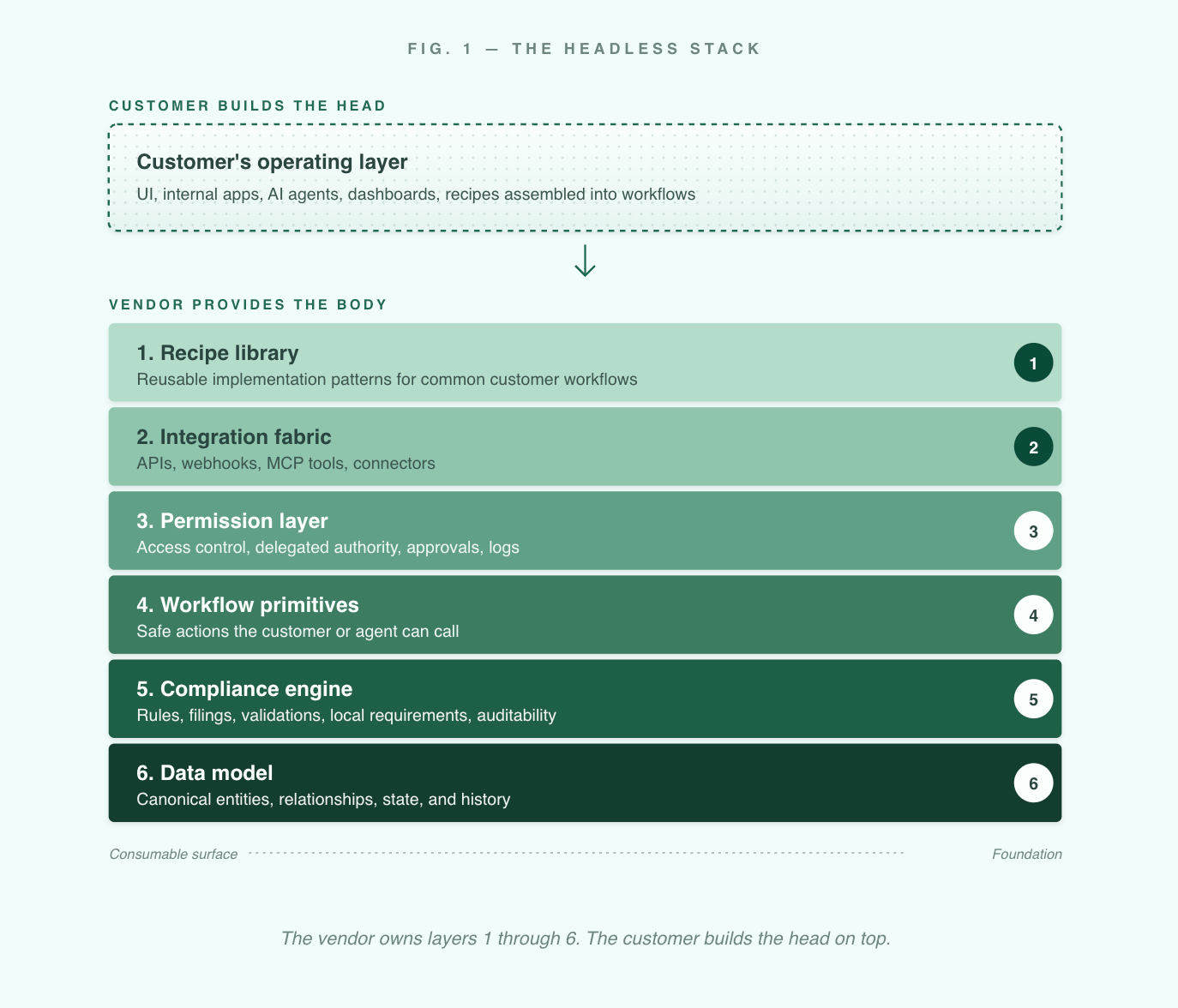
The “recipe library” matters more than it sounds.
Customers do not just want raw infrastructure. They want to know how to assemble it. A headless ATS vendor, for example, should not only expose candidate, job, scorecard, and interview APIs. It should provide recipes for “screen inbound applicants,” “schedule interviews,” “generate offer letters,” “run equal-employment reporting,” and “sync hired candidates into HRIS.”
This is where forward deployed engineers become important. Their job is not to create endless bespoke consulting work. Their job is to help customers implement the system, learn from the deployment, and turn those learnings into reusable recipes.
That is how the model scales.
The ATS example: why pay for the room if you only need the rails?
Applicant tracking systems are one of the clearest early categories for headless disruption.
Recruiting teams often pay for seats so people can log into an ATS, move candidates through stages, leave notes, schedule interviews, and generate reports. But much of that workflow is now agent-friendly.
Imagine a mid-sized company with a recruiting team that mostly works in Slack, email, calendar, and an internal hiring dashboard. In a headless world, the ATS vendor provides the underlying recruiting primitives:
candidate profiles
job and pipeline data
interview scheduling hooks
scorecards
compliance reporting
offer-letter workflows
audit logs
permissions
integrations into HRIS and calendar systems
The company builds its own hiring interface on top. Recruiters do not need to live inside the ATS. An agent can summarize candidates, schedule interviews, nudge hiring managers, update pipeline stages, draft rejection emails, and surface decisions where the team already works.
The ATS vendor still earns money. But it earns it from workflow execution, API usage, compliance coverage, or hiring volume, not necessarily from every human who needs to look at a candidate record.
This is compelling because it gives the customer control without forcing them to rebuild the sensitive parts.
They own the head. The vendor owns the rails.
HRIS and payroll: harder to replace, very likely to go headless
HRIS and payroll are different.
A company may happily replace the interface of its HR system, but it is much less likely to rebuild payroll compliance. Payroll involves filings, taxes, benefits, local laws, country-specific rules, payment timing, employee records, and audit exposure.
That makes HRIS and payroll less vulnerable as systems of record, but very attractive as headless infrastructure.
The future HR stack may not be “replace Workday with a chatbot.” That is the lazy version of the thesis.
The stronger version is: keep the compliant backend, but let the customer build the employee operating layer they actually want.
A company might use a headless HRIS or payroll provider for:
employee records
onboarding and offboarding actions
payroll calculations
tax and compliance rules
benefits logic
document generation
approval flows
audit trails
employee status changes
integrations into finance, IT, and identity systems
Then it builds its own internal people OS on top: an AI assistant for employees, a manager dashboard, a finance planning view, a workforce analytics layer, and custom workflows that match how the company actually operates.
This is not less valuable to customers. It is more valuable.
They get the compliance they cannot afford to mess up, while escaping the one-size-fits-all interface.
Why customers care: the intelligence layer
The most compelling reason customers will care about headless SaaS is not cost.
It is context.
Every company is trying to build a more intelligent operating system. They want an AI layer that can reason across sales, finance, people, support, operations, documents, and customer data. But today, that intelligence layer is trapped behind fragmented SaaS interfaces and brittle integrations.
The customer has to pull data out of one system, transform it, pipe it into another, and hope the permissions survive the journey.
Headless SaaS changes the architecture.
If every major system exposes its data and actions through clean APIs and MCP tools, the customer’s AI layer can sit naturally across the business. It can ask the HR system about headcount, the CRM about pipeline, the accounting system about revenue, the support system about customer issues, and the ATS about hiring velocity.
More importantly, it can act.
That is why the shift is compelling. Customers are not just trying to save on SaaS bills. They are trying to own the context layer where their AI lives.
In the old world, every SaaS product wanted to be the place where work happened.
In the new world, the customer wants work to happen in its own operating layer.
Why this is especially compelling for medium-sized businesses
The Fortune 500 will build a lot of this internally. They have large engineering teams, data teams, procurement power, and the patience to run multi-year transformation programs.
Small companies may continue to use packaged software because it is simple and good enough.
The most interesting market is in the middle.
Medium-sized businesses are large enough to have complex operations, but not large enough to justify massive enterprise software spend or permanent internal platform teams. They feel the pain of generic SaaS earlier than people think. Their processes are becoming unique. Their teams are growing. Their data is scattered. Their software bills are expanding. But they cannot always afford to hire the army required to build everything from scratch.
Headless SaaS is almost perfectly shaped for them.
It lets them rent the hard parts: compliance, infrastructure, integrations, and governed actions. Then they can build the differentiating layer: the workflows, dashboards, agents, and operating system that match how their business actually works.
This is why the category could expand quickly. Medium businesses do not want “more software.” They want their systems to finally fit.
What vendors need to do now
Incumbent vendors should not treat this as a feature request. It is a business model shift.
Salesforce is the useful reference point here. Agentforce 360 and the Slack “agentic OS” push are not just AI feature launches; they show how a large incumbent can try to keep the system of record, the data layer, and the governed workflow layer even as the user experience moves into chat, agents, and other surfaces. That is the playbook other vendors should study.
If customers stop living inside the UI, then vendors need to make the underlying product easier to consume, easier to trust, and easier to compose.
The urgent work is clear.
Expose the product properly. APIs cannot be afterthoughts. MCP servers, webhooks, workflow endpoints, event streams, and documentation should become first-class product surfaces. Salesforce is already trying to make CRM data and actions reachable outside the classic Salesforce UI; that is the standard customers will start expecting everywhere.
Make actions safe. If agents are going to execute workflows, vendors need granular permissions, approval steps, audit trails, rollbacks, and strong observability.
Build recipes, not just endpoints. Customers do not want a thousand API docs and good luck. They want implementation patterns: “how to build a recruiting agent,” “how to automate onboarding,” “how to sync payroll changes into finance.”
Create a forward deployed motion. The winners will help customers implement. Not as generic consulting, but as a repeatable deployment motion that feeds back into product.
Rethink pricing. Per-seat pricing will not disappear overnight, but it will become less central. If agents consume the product, then pricing needs to reflect usage, actions, workflows, compliance coverage, outcomes, or platform access.
The browser seat becomes an admin seat. The real monetization shifts to governed actions, compliance coverage, and deployment leverage.
Vendors who move fast can own the new layer. Vendors who wait may discover that smaller teams have rebuilt the customer experience on top of their APIs, and captured the relationship.
The pricing question
Nobody knows the final pricing model yet. Anyone who says they do is probably selling something.
But a few models are worth testing:
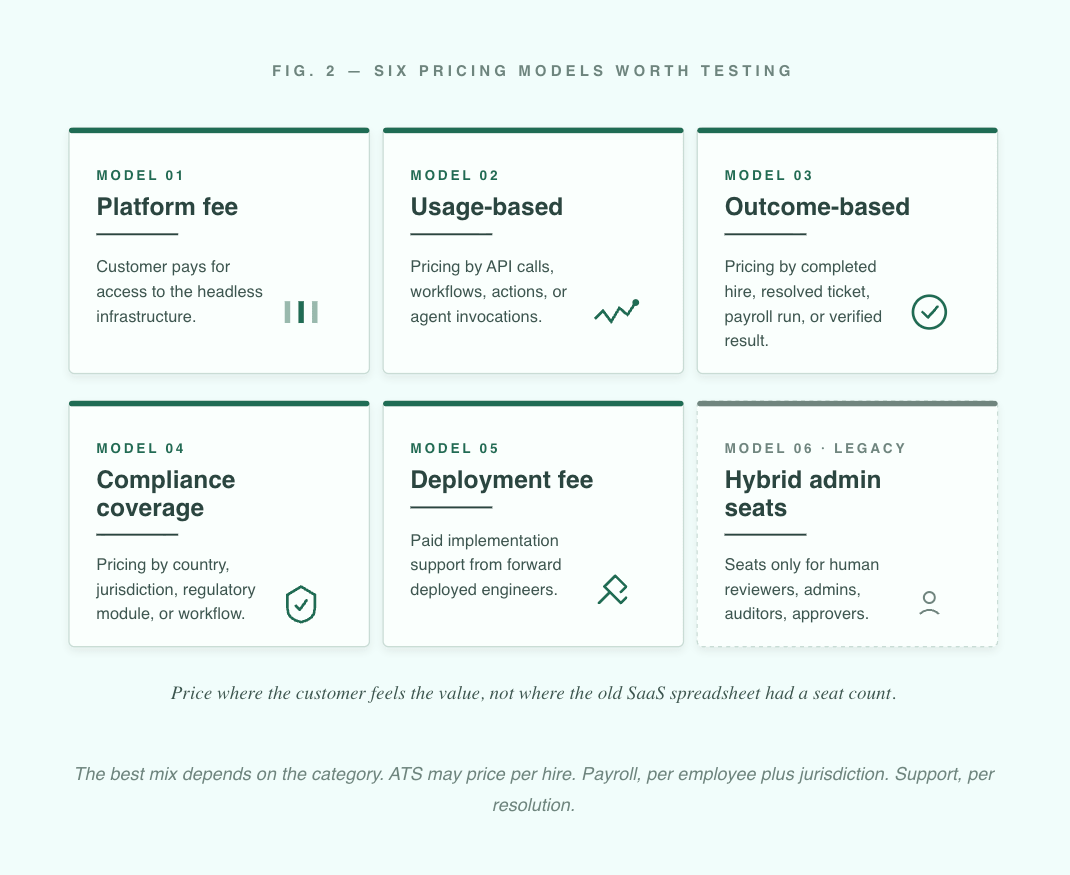
The best model will depend on the category. ATS might price per hire or workflow volume. Payroll might price by employee, jurisdiction, and payroll run. Customer support might price by resolution. Internal tooling platforms might price by usage and governance tier.
The principle is simple: price where the customer feels the value, not where the old SaaS spreadsheet had a seat count.
The honest risks
There are good reasons to be cautious.
First, most companies are not good at building software. AI makes building faster, but it does not automatically create good architecture. A badly assembled internal OS can become a mess of brittle integrations, undocumented workflows, and invisible dependencies.
Second, agents introduce new risk. If an AI system has authority to act, mistakes can compound quickly. A wrong recommendation is one thing. A wrong payroll action, compliance filing, candidate rejection, or customer refund is another.
Third, vendors may simply recreate lock-in at the API layer. If customers build deeply around one provider’s primitives, they may escape the UI only to become dependent on the backend.
Fourth, the FDE model can become expensive. If every customer requires heavy custom work forever, the company becomes a consulting business with software margins in the pitch deck only.
These are real risks. But they do not invalidate the thesis. They define the execution bar.
The winners will be the companies that combine strong primitives, open standards, excellent documentation, reusable recipes, safe agent controls, and a deployment motion that becomes more productized over time.
The opportunity
The opportunity is not to kill SaaS.
The opportunity is to rebuild where SaaS lives.
For the last twenty years, software companies competed to own the interface. The next generation will compete to own the trusted primitives underneath the customer’s operating layer.
That means the most interesting companies may not look like traditional SaaS companies. They may look like infrastructure companies with domain expertise. Or compliance companies with APIs. Or workflow companies with recipe libraries. Or deployment companies that slowly productize the patterns they see in the field.
Software is losing its head. But the body underneath may become more valuable than ever.
For customers, especially medium-sized businesses, the promise is powerful: keep the hard parts you cannot safely rebuild, and own the layer that makes your business distinct.
For vendors, the warning is just as clear: if your product’s main moat is that users are trained to click through your screens, the clock is running.
The smaller companies that understand this shift will not attack you by copying your UI. They will attack by making your UI irrelevant.
Software is losing its head. But the body underneath may become more valuable than ever.